Fire safety law
Fire Safety (England) Regulations 2022: duties for flats
Find out what the fire safety england regulations 2022 require from anyone managing a block of flats in Maidstone, from door checks to resident information and the extra duties that apply to taller buildings.

The 2022 regulations responsible person duties in Maidstone
If you manage a block of flats in Maidstone, the fire safety england regulations 2022 added specific tasks to your existing responsibilities. These 2022 regulations responsible person duties apply regardless of building height, so even a small converted house split into three flats must comply.
The core requirements cover giving residents fire safety information, checking flat entrance doors and keeping communal areas clear. A specialist firm can review the building and confirm which duties apply to your particular layout. Many landlords across Maidstone, including those with properties in Larkfield or Barming, find that a fresh look at their [fire risk assessment](/fire-risk-assessment-maidstone) is the quickest way to see where they stand.
The law places these obligations on the responsible person. That might be a freeholder, a managing agent or a residents' management company. If a previous managing agent did none of this, the duty does not disappear. It sits with whoever holds the responsible person role now. A new agent or landlord inherits the obligation immediately, so arranging a compliance check early avoids problems later.
Flat entrance doors and quarterly fire door checks
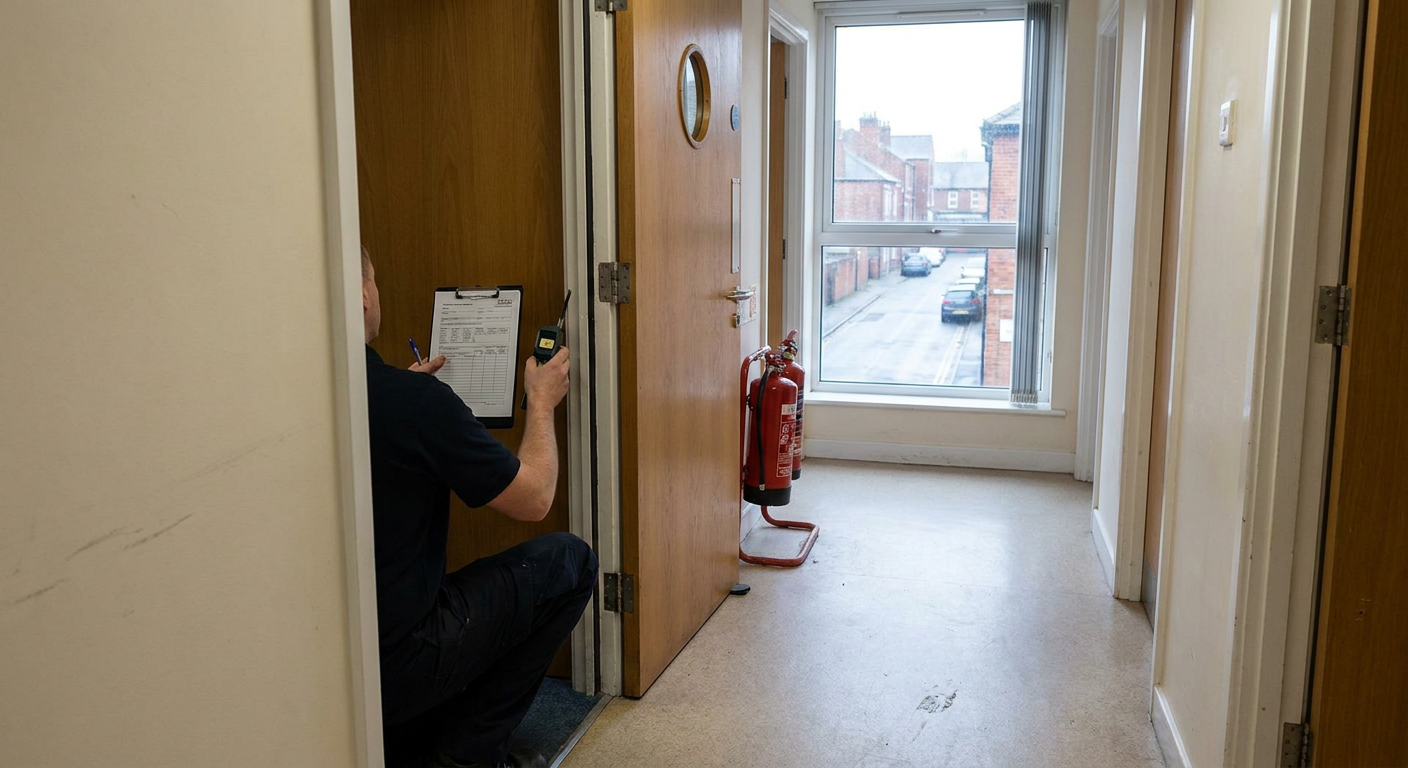
Every flat entrance door that opens onto a communal area needs regular attention. The Fire Safety (England) Regulations 2022 require quarterly fire door checks on all such doors in blocks over eleven metres, but good practice means inspecting them in smaller buildings too. A competent person must carry out these inspections. Competence here means someone trained to identify faults like damaged seals, broken closers or gaps around the frame. That training might come from a recognised course or documented instruction from a specialist firm. It does not have to be a carpenter every time; routine visual checks can be done by a managing agent or caretaker who holds proof of that training.
A specialist firm handles detailed inspections and produces a written report. They look at the self-closing mechanism, the intumescent strips and the fit of the door in its frame. You can read more about what a thorough [fire door inspection](/fire-door-inspection-maidstone) involves and how faults are recorded.
Communal doors separating a stairwell from a lobby need checking too. Keeping a log of every inspection shows you have met the 2022 regulations responsible person duties. If a door fails, the specialist recommends remedial work. Prompt repairs keep the compartmentation intact, which is the main reason these checks exist.
The resident fire safety information duty
You must give residents clear instructions about what to do if a fire breaks out. This resident fire safety information duty covers the evacuation strategy, how to report a fire and why keeping communal corridors clear matters. The information has to be provided when someone moves in and again whenever the building's strategy changes. It should also be reissued to all residents at least once a year.
How you send it is up to you. A letter through the door, an email or a notice in a communal display board all count, so long as you can show it was issued. Written procedures form part of your wider [fire safety policy](/fire-safety-policy-and-procedures-maidstone), and a specialist firm can help draft wording that meets the requirement without confusing people who live there.
Residents need to know whether the building operates a stay-put policy or simultaneous evacuation. Getting this wrong causes panic during an alarm. Clear, repeated communication prevents that. Some managing agents pair the annual notice with basic [fire safety awareness training](/fire-safety-awareness-training-maidstone) sessions for staff who work in larger blocks.
Eleven metre building requirements and taller blocks
Height triggers extra duties. To work out if your building falls under the eleven metre building requirements, measure from the lowest ground level next to the building to the floor of the top storey. If that distance exceeds eleven metres, the quarterly door checks mentioned above become mandatory rather than advisory.
Buildings over eighteen metres face further obligations. These include installing a secure information box block near the main entrance. The box holds contact details for the responsible person, floor plans and information about firefighting equipment. Kent Fire and Rescue Service can access it during an incident, so it must be kept locked but available to crews.
For taller blocks, you must also provide the fire service with electronic floor plans and details of the external wall system. This information helps crews plan before they arrive. A specialist firm can compile the pack and submit it. Whether your block is in Aylesford or central Maidstone, the height thresholds are fixed in law and do not vary by location.
Wayfinding signage in the stairwell
Stairwells in blocks of flats need wayfinding signage so firefighters can identify floors and individual flats quickly in smoke. The signs must show the floor number and, where relevant, the flat numbers reached from that landing. They need to be positioned consistently on each level and made from materials that remain visible in low light.
Photoluminescent signs are standard. They absorb light and glow when the power fails. The regulations specify minimum sizes and placement heights so crews from any station recognise the format immediately. A specialist firm advises on the correct layout and supplies signs that meet the standard.
This requirement applies to all blocks containing two or more dwellings, regardless of height. Even a short stairwell serving four flats needs clear identification. Missing or incorrect signage is one of the most common faults found during inspections. Correcting it is straightforward once you know what the rules demand. An up-to-date [evacuation plan](/fire-evacuation-plans-maidstone) references these signs so everyone understands the route out.
Common questions about the 2022 flat duties
Answers to the things landlords and managing agents in Maidstone ask most often about the regulations.
- Which duties apply to a small block?
- All blocks of flats must provide resident information, maintain wayfinding signs and ensure doors close properly. Quarterly checks apply only above eleven metres.
- Who can check the fire doors?
- Routine visual checks can be done by a trained caretaker. Detailed inspections should be carried out by a specialist firm experienced in fire door assessment.
- What records prove compliance?
- Keep dated logs of door checks, copies of resident information letters, maintenance reports and any correspondence with the fire service about floor plans.
- Must we send plans to the fire service?
- Yes, if the building is over eighteen metres. Electronic floor plans and external wall details go to Kent Fire and Rescue Service via a secure portal.
- What if the old agent did nothing?
- The duty transfers to the current responsible person. Arrange a compliance review promptly to identify gaps and bring the building up to standard.
- Do we need a nominated person?
- Larger or higher-risk buildings benefit from naming someone to oversee these tasks. A [nominated person](/nominated-person-service-maidstone) keeps the schedule on track.
Ask about the 2022 regulations for your flats
Send the details of your block in Maidstone and a specialist firm will respond with what is required. There is no obligation to proceed beyond that first conversation.
- No commitment required
- Local specialists respond
- Written scope provided